How to Avoid Greenwashing
When Shopping for Clothing in Australia
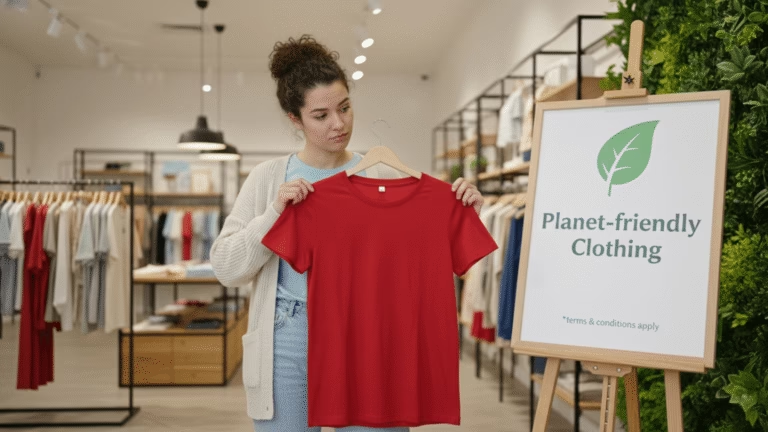
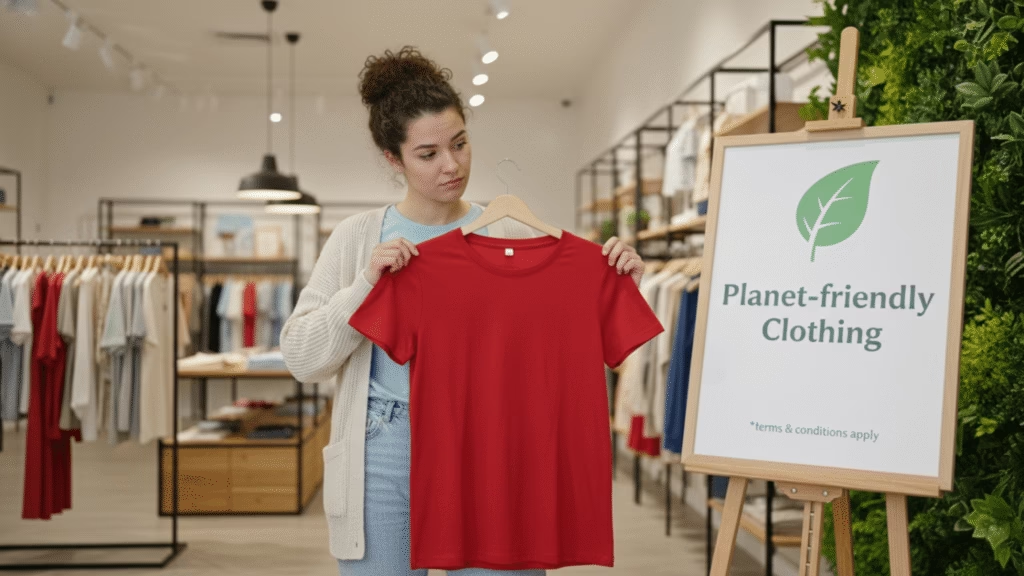
Greenwashing has quietly become one of the biggest problems in Australian fashion. Brands know shoppers care about sustainability — so instead of improving their practices, many simply improve their marketing. The result? Misleading claims, vague “eco” language, and a level of confusion that makes it harder for genuinely ethical brands to stand out.
This guide breaks down exactly how to recognise greenwashing and how to confidently shop for truly ethical and sustainable clothing in Australia — building on the same principles behind ethical fashion in Australia, where transparency, materials, and verified standards all work together.
Sustainability in fashion isn’t static — standards evolve, expectations shift, and no brand gets everything perfect. What matters is whether claims are backed by evidence, and whether brands are transparent about where they are now and where they’re improving.
What Greenwashing Actually Looks Like in Australia
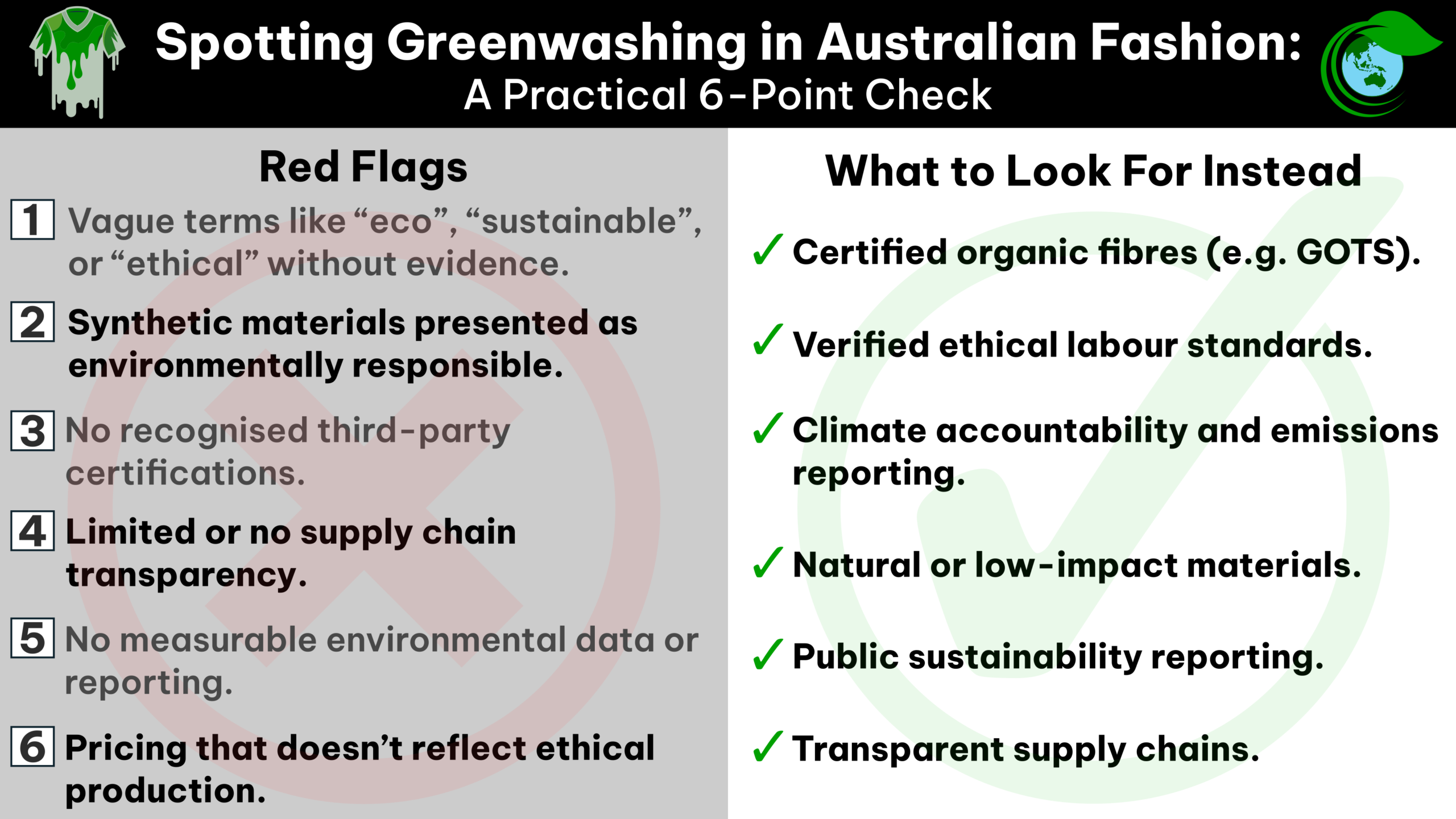
Greenwashing happens when a brand presents itself as environmentally responsible without backing those claims with evidence. In fashion, this often shows up as:
Buzzwords like “sustainable”, “ethical”, “green”, or “conscious”
Earthy imagery, leaves, and beige tones to imply eco-friendliness
Highlighting one tiny action while hiding major issues
No supply chain information
No certifications
No environmental reporting
Polyester-heavy products marketed as “eco”
Even the Australian Competition and Consumer Commission (ACCC) has launched investigations into misleading environmental claims across Australia.
When sustainability becomes a marketing trend, misinformation becomes a problem — and shoppers deserve clarity.
🚩 The 7 Red Flags to Watch for When Shopping Clothing:
1. No Certifications or Fake-Sounding Labels
If a brand uses words like “ethical” or “eco-friendly” without any third-party verification, that’s a major warning sign.
But not all certifications are equal — and not all are even relevant to clothing.
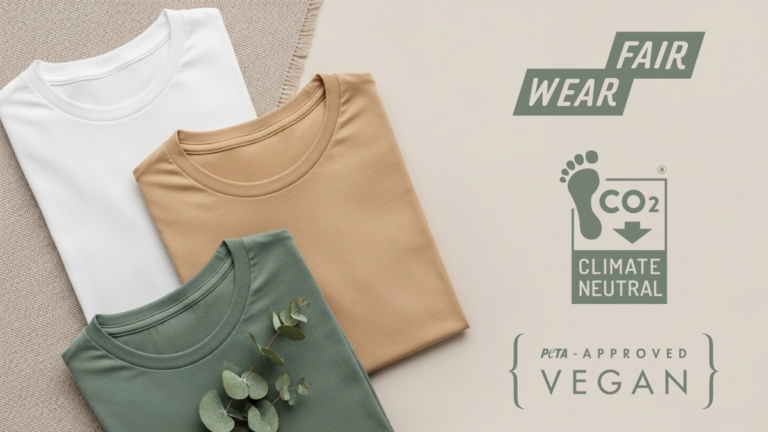
In apparel, standards like Fair Wear Foundation, GOTS, and OEKO-TEX® provide meaningful oversight because they assess real-world conditions — from factory labour practices to chemical safety and fibre integrity.
Without this level of verification, “ethical” stops being a standard and becomes a marketing choice — which is exactly where greenwashing thrives.
2. Overly General Buzzwords
If a brand uses sustainability language but doesn’t explain how, consider it a red flag.
“Eco-friendly materials” means nothing unless fibres are named and verified.
3. No Transparency About Factories or Materials
Brands committed to ethics proudly share manufacturing partners, fibre sourcing, and working conditions. This level of transparency is a core pillar of how organic cotton supports ethical apparel in Australia, where material sourcing and production are fully traceable.
4. Highlighting One Good Thing Only
5. Hiding Polyester Behind Fancy Wording
Terms like “recycled polyester”, “responsible polyester”, or “eco-fleece” try to distract from the fact that polyester is still plastic, still sheds microplastics, and still contributes to fossil fuel reliance.
Brands often label synthetic materials as “eco” or “sustainable,” but the reality is more complicated — especially when you understand the difference between organic cotton and polyester.
If you want to understand why fibre choice matters, our deep dive into the environmental impact of cotton in Australia provides essential context.
6. No Environmental Data
Brands serious about sustainability publish carbon, water, and chemical data. Transparency benchmarks are tracked globally by the Fashion Revolution Transparency Index, which highlights how few brands actually disclose meaningful information.
7. A Price That Doesn’t Make Ethical Sense
One of the most common greenwashing tactics is focusing on a low upfront price, while ignoring the true cost per wear over the garment’s lifetime.
If a shirt costs less than a cup of coffee, ethical labour and responsible materials simply aren’t possible — regardless of the branding.
💚 The 7 Ways to Actually Verify a Brand Is Ethical
1. Look for Recognised Certifications
Certifications only matter when they are relevant, verifiable, and specific to how clothing is actually made.
- GOTS (Global Organic Textile Standard) – verifies organic fibre content, chemical processing, and supply chain integrity
- Fair Wear Foundation – focuses specifically on labour conditions in garment factories
- OEKO-TEX® – ensures textiles are tested for harmful substances
- PETA Approved Vegan – confirms no animal-derived materials are used
- Climate accountability (where disclosed) – credible brands measure, reduce, and transparently report emissions rather than relying on vague “carbon neutral” claims
What matters isn’t how many logos a brand displays — it’s whether those standards are clearly explained, independently verified, and relevant to the product itself.
2. Supply Chain Transparency
Ethical brands openly share:
Factory names and locations
Worker protections
Wages
Certifications
Policies
3. Environmental Reporting
Look for brands that disclose:
Their carbon emissions
Water usage
Chemical management (ZDHC)
Yearly improvement reports
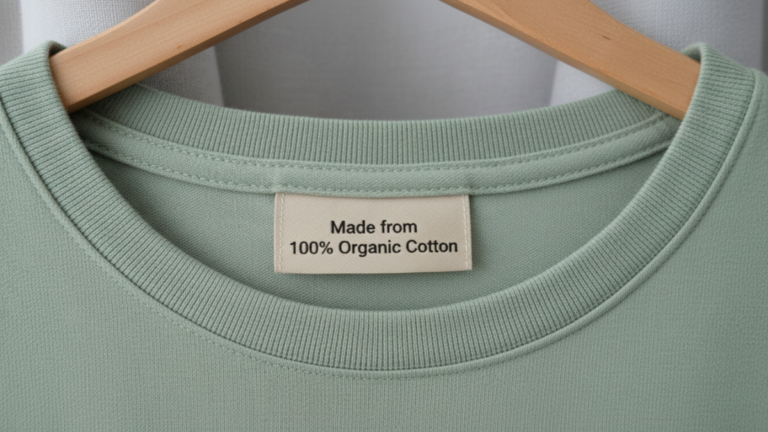
4. Read Fibre Content Carefully
Prioritise:
Organic cotton
Linen
Hemp
Modal/Tencel (certified)
Avoid heavy poly blends, polyester knits, acrylic, nylon, and “eco-fleece.”
5. Evaluate Durability
Sustainability isn’t just about materials — it’s about longevity. High-quality organic cotton lasts dramatically longer than cheap synthetics.
Look for things such as high GSM organic cotton and reinforced seams.
6. Review Brand Policies
Ethical brands often provide sustainability commitments, repair programs, transparent returns, longevity guarantees and recycling support.
7. Use Third-Party Ratings & Directories
Independent directories and rating platforms can also help verify claims when you’re unsure — especially when combined with certification checks and supply chain transparency.
If you want a clearer benchmark for what genuinely ethical clothing should look like — from certifications and fibre choices to supply chain transparency — our guide to choosing ethical apparel in Australia breaks it down into a practical framework you can actually use when shopping.
What Ethical Clothing Looks Like (A True Example)

To understand what this looks like in practice, it helps to look at brands that prioritise verified standards over broad claims — where materials, certifications, and transparency are all clearly defined.
Every item in our organic clothing collection is:
- Certified organic cotton under GOTS
- Tested against harmful substances through OEKO-TEX® standards
- Manufactured in facilities monitored by the Fair Wear Foundation
- Independently verified low-carbon production, with emissions reduced at the source by up to 90% through renewable energy and low-impact manufacturing (Carbon Trust verified)
- PETA Approved Vegan (no animal-derived materials)
- Contains no synthetic fibre blends in the main fabric, with only minor synthetic elements used in trims such as stitching, labels, or elastics where required for durability.
- Shipped carbon-neutral and plastic-free in home-compostable packaging
- Clear, traceable supply chain from raw fibre through to finished garment
These certifications represent the core standards behind each product, with additional verification and supply chain details available on our materials and standards page.
This is what separates genuine sustainability from surface-level claims — not perfection, but transparency, verification, and a willingness to be measured against real standards.
To understand the principles behind this approach, you can also explore our commitment to ethical apparel in Australia.
Greenwashing thrives when sustainability feels vague or difficult to verify. The more clearly brands explain their materials, certifications, and production processes, the easier it becomes to separate meaningful action from marketing.
When brands make sustainability measurable, trust stops being a guess — and starts being earned.
Before you buy, ask these:
☐ Does the brand offer third-party certifications?
☐ Are factories named and transparent?
☐ Do they publish environmental reports?
☐ Are materials clearly listed?
☐ Is polyester disguised with clever wording?
☐ Does the price reflect ethical labour?
☐ Do they offer responsible policies?
If the answer is no to most of these, you’ve likely found greenwashing.
Greenwashing Fashion FAQs
What is greenwashing in Australian fashion?
Greenwashing is when brands present themselves as sustainable without providing clear, verifiable evidence to support those claims.
How can I avoid greenwashing when buying clothes?
Look for recognised certifications, transparent supply chains, clearly stated materials, and publicly available environmental data.
Is recycled polyester a sustainable option?
It can reduce waste in some contexts, but it still relies on plastic and continues to shed microplastics, which limits its overall environmental benefit.
What materials are generally more sustainable?
Certified organic cotton, linen, hemp, and responsibly produced cellulosic fibres are typically lower-impact and easier to trace.